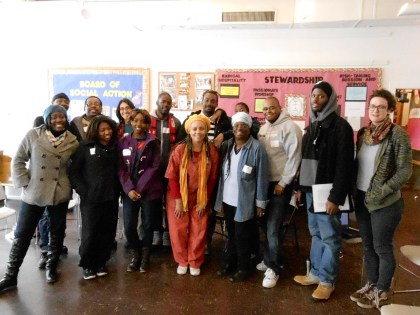
Notes from the Creative Governance Dinner

Earlier this month, about 15 people got together to share examples of how cooperative governance structures can change the way work works. We focused on different organizations – including Equal Exchange, Semco Brazil, and Alcoholics Anonymous – and answered the questions:EE worker owner model

– How are different types of decisions made?

– What are the roles and the relationships between roles?

– How is the strategic direction determined?

There was a lot of interest in continuing the conversation, so stay tuned and feel free to throw out ideas!

You can view and add to the notes here.


6 Ways to Fuel the Cooperative Takeover

The spring issue of YES! Magazine is about how cooperatives are driving a new economy. From the discussion by the editors of the magazine, “Co-ops aren’t new. What’s ncooperativesew are the opportunities we now have to expand the reach of the cooperative economy:

  • Unions are joining forces with Spain’s successful Mondragon Cooperatives to bring the model to the United States.
  • Communities looking for alternatives to expensive, for-profit health insurance are forming health care cooperatives.
  • Thousands who “moved their money” from Wall Street banks to credit unions now have a say in how that money is loaned and invested.
  • Consumers looking for ways to increase prosperity for small-scale producers are turning to cooperatives like Equal Exchange.

Instead of making more money for those who are already wealthy, cooperatives offer everyone ownership of an economy that benefits all life.”

Update on Nature’s Friends Sunflower Field School – Teen Farming Cooperative

By Reverend Dele

Field School Students March 2013

Phase two of the Sunflower Field School orientation took place on Saturday, March 9, 2013 at Plymouth Congregational UCC with four of our participating organizations in attendance– the Glenncrest Community/Make A Difference House Youth Ambassadors; Sasha Bruce House and Beet Street Gardens’ Youth Garden Stewards/Yolo Pies; and the Fairfax Village Community Garden. These groups represent 11,500 square feet of urban land which can be restored to regenerating ecosystems. Presentations from Gail Taylor, Zachari Curtis, and Xavier Brown during the first session modeled our ethic of open sharing for the youth.

The excitement generated during the first session carried over to this week’s session as the groups shared scaled drawings of their growing spaces, were guided in their presentation of break even analysis homework assignments, as well as in sunflower yield calculations. After just two hours of working together, many of the participants, for whom the concepts were new and who initially shied away from some very different calculations, demonstrated a better grasp of the material and confidence in carrying out the calculations.

The session also included an exploration into the practice of co-ops as Allison shared with the teens and sponsors the philosophy, principles, types and the overall co-op landscape in DC. Sponsors had the opportunity to meet separately to discuss program outcomes and logistics.

Although this was the last of the two part orientation, everyone left energized knowing that the seeds of working together were just being planted and the future was ripe for a bountiful harvest of many kinds — a model teen co-op enterprise, emerging youth leaders, urban growers and environmental stewards, employment opportunities, job skills, organization partnerships, a bumper crop of sunflowers, newly established markets and more!

Organizations agreed to identify time for monthly planning and work share sessions and Nature’s Friends will make site visits to growing sites in April; finalize the workbook and will distribute sunflower seeds for planting in May. Nature’s Friends may facilitate other relevant trainings as funding becomes available. Thus, the focus over the next couple of months will be fundraising and organizational capacity. We’re looking forward to the evolution of the teen farming co-op and the best practices we will be able to share with the local and national community.

Invest in Cooperatives

At least one person in our group has invested in Northcountry Cooperative Development Fund (NCDF). It’s great! Northcountry Cooperative Development Fund is a cooperatively owned community-development loan fund committed to fostering economic democracy by investing in cooperative enterprises. Based in Minneapolis, Minnesota, NCDF currently serves more than 175 co-op members in 30 states, including natural food, consumer, producer, housing and worker-owned cooperatives.

A federally certified Community Development Finance Institution (CDFI), NCDF creates opportunities for cooperatives and social investors to invest in the national cooperative movement, with an emphasis on community development within economically challenged and underserved communities. Since its founding in 1978, NCDF has originated over $31 million in cooperative financing.

Recent Loans
Bloomington Cooperative Living, Bloomington, Indiana

$400,000 from NCDF as part of a $500,000 package that includes Religious Communities Investment Fund and KSCR Fund (administered by NCDF).  The loan was used to purchase and renovate the first home owned by the co-op, which will expand the housing available to students and community members
$160,000 to refinance their mortgage and make upgrades to their building.
Isla Vista Food Co-op, Isla Vista, California
$200,000 as part of the financing package with NCB for the $1,625,000 purchase of their building.

What’s next for the DC coop movement?

On Jan 13th, a small group of us met to discuss the potential to try to pass a local version of the National Cooperative Development Act. This act provides funding for loans and seed capital to cooperatives, and grants to organizations that provide technical assistance to cooperatives.

Because UDC’s Kirkman Center for Cooperatives is primarily a research resource right now and we don’t have strong (or any?) technical assistance providers in DC, we felt like this particular legislative battle isn’t the first step in building a more vibrant cooperative ecosystem in DC. We discussed the Cooperation Texas model, which provides affordable training and technical assistance to worker cooperatives. Some people on the Coop DC list serve have been forming Coop Incubator DC, though no one at the meeting has been able to get in touch with the group members recently for an update. We hope when it’s up and running it can help to fill this gap in the city. In the meantime, there are several groups looking for information on starting a cooperative. Eva is hoping to be able to provide legal support to cooperatives full time after graduating, which is great.

One of the groups is Nature’s Friends, run by Dele. She’s organizing a sunflower seed cooperative for DC youth gardeners. The sunflower seed gardening trainings will take place on March 2 and 9. People at the meeting offered both direct support and to make connections to others who can support the project.

What’s next? We keep making connections and organizing trainings and learning opportunities until DC has a cooperative technical assistance provider that fills some of this gap. As always, ideas are welcome.

Attendees: Josephine, Kara, Dele, Amanda, Greg, Eva, Allison
_______________________

Other updates we learned after the meeting:

American and Georgetown University professor John Whitman and UDC law professor and clinic director Louise Howells are working to pass a worker coop friendly statute in DC. UDC law students will be working on this during the Spring 2013 semester.

John Whitman is also hoping to engage the DC Office of Employment Services in providing worker coop training, probably through their existing Workforce Training contractors. Here they especially want to engage those re-entering the community from prison.

He also hopes to promote teaching about coops in business and law schools, but this largely depends on student demand, so students should let their deans know. You can check out cooperative curricula here: http://cooperative-curriculum.wikispaces.com/

Can DC learn from Texas?

Cooperation Texas is the only worker cooperative development center iGraduation_Dahlia1-300x200n Texas:

Founded in October 2009 in response to growing economic inequality, Cooperation Texas is an Austin-based non-profit committed to the creation of sustainable jobs through the development, support and promotion of worker-owned cooperatives. We believe everyone deserves equal access to dignified employment, which is why we place those most directly affected by social and economic inequality at the center of our work. We provide education, training and technical assistance to existing and start-up worker cooperatives in all sectors of the economy, helping launch and strengthen Texas businesses that put people and the planet first.

There is discussion of a similar program here in the District, the DC Coop Incubator…

Weaver of Dreams: Founders of the Modern Cooperative Movement

WeaverThe “Foreword” below is from the book Weavers of Dreams: Founders of the Modern Cooperative Movement (1995) by David J. Thompson that has been reissued in 2012 in celebration of the United Nations’ “International Year of Cooperatives”. The foreword was written by Bruce Thordarson, who was then the Director General of the International Co-operative Alliance. The 150th anniversary of the Rochdale Cooperative Principles was in 1994-95.

The story of the Rochdale Pioneers, and their role laying the foundations of today’s worldwide Co-operative Movement has been told before in many ways. To mark the 150th anniversary of the founding of the Rochdale Equitable Pioneers Society, David Thompson has chosen the approach of a true believer-a committed community developer who sees Co-operation as a means for achieving the twin goals of progress and equity.

The economic and social conditions facing the working class people of Northern England during the first half of the nineteenth century…leave no doubt that Co-operation emerged, as it usually does, as a collective response to keenly felt needs. These were primarily economic needs, but to a significant extent they were also social–a desire for basic education, for political rights, and for more equitable participation of women. The Rochdale Pioneers, as Co-operative leaders after them have done throughout the world, were concerned with both economic and social forms of justice. They sought to combine the development of a strong, economic enterprise with contributions toward social and political rights.

What is striking from this account, in fact, is the extent to which the British Co-operative movement of the 19th Century exercised a significant influence in the development of national policies in such areas as consumer standards, women’s rights, and popular education. The Co-operative Women’s Guild is described as “Britain’s pre-eminent women’s organization,” and its parliamentary successes were significant indeed.

Like the author himself, the early Co-operative leaders were strong idealists. It is not surprising, therefore, that the door of the Rochdale store was painted a bright green-the symbol of the Chartist Movement which had inspired many of the Rochdale Pioneers. But whether Owenites, Chartists, or Christian Socialists, the early leaders also realized the need to emphasize common values, which would untie rather than divide their members.

As is well known, the Rochdale Society was not the first Co-operative in Britain. But, for a variety of reasons, it has become the symbol for a movement, which is today world-wide and multi-sectoral. In large part, this is due to the Pioneers’ wise and judicious financial policies. They emphasized the importance of member contributions to capital-as much as 10 weeks’ wages -so as to avoid the problems of undercapitalized Co-operatives whose fate they wished to avoid. In order to attract this capital, the Co-operative paid a fair market rate, ranging from 3.5 to 5 percent. Equally important was its codification of the practice of dividends on purchases-both to ensure sufficient reserves for the Co-operative and to reward the individual member for his patronage. The wisdom of such policies remains apparent 150 years later.

When modern readers attempt to understand the reasons for the success of the first consumer Co-operative, it is important to remember that its attraction was based on the values of quality and honesty. The attraction of “pure food” and “honest weight,” combined with financial statements that were open to all members, demonstrated that the Co-operators was truly an alternative form of business operating in the interests of its users/owners.

Another characteristic of the early Co-operative leaders in Britain was their understanding of the need for vertical integration, not only in order to attain economies of scale for their consumer operations, but also to extend the benefits of Co-operation into other areas-manufacturing, farming, financially services, and education. The stories of the Co-operative Wholesale Society, the Co-operators Bank, the Co-operative Insurance Society, and the Co-operative Union have been told in detail elsewhere. For the purpose of this account, the important message is that attention to local matters-while essential-is not sufficient. Committed Co-operative leaders realize that their success ultimately depends upon a wider public understanding of co-operation, which in turn requires Co-operative action at both national and international levels.

This is certainly David Thompson’s view, as attested by the attention which he pays to the efforts of the British Co-operative Movement to support both Co-operative education and housing. It is revealing that the Rochdale Society was allocating 10 percent of its profits to education (until the government’s Registrar forced it to reduce this amount), and that it soon became “the foremost educational institute in Rochdale.”

Today, some 150 years later, the concepts developed by the Rochdale Pioneers and their successors have spread around the world, joined and adapted by other philosophies and other cultures. The Co-operative model is today truly universal, but still reflects very much the values and principles which inspired the weavers of Rochdale. Their vision does indeed deserve to be celebrated in this anniversary year.

Bruce Thordarson, Director General, International Co-operative Alliance, Geneva, Switzerland (1995) For more information go to Weavers of Dreams: Founders of the Modern Cooperative Movement  by David J. Thompson (2012)    

This Morning and Tonight: Shift Change movie

There are 2 screenings for the movie Shift Change on today. One is at 11am and the other at 7:30pm at E St Cinema. You can RSVP here:  http://community-wealth.org/shiftchange and on facebook here: http://www.facebook.com/events/312201322228050/?fref=ts You can watch the trailer here: http://shiftchange.org/video-clips/ Today’s “Morning Brew” show on WPFW had some great audio clips from the movie.
See you there!