Category: Uncategorized
New nation-wide cooperative map!
The Black Socialists of America have put together a “dual-power map” of the United States and a broad strategy that I highly recommend exploring:
“We’ve meticulously plotted every single Worker Cooperative, Small Business Development Center, Community Land Trust, and Dual Power Project within the United States that you can support right now, and will be updating as time goes on.”
Zooming in on DC in the map shows how much work is needed to rebuild the growing cooperative economy DC had in the 1970s. Today’s cooperative economy is being created in new ways along with past experiences. The Black Socialists of America vision builds on the example of Cooperation Jackson in Mississippi and Symbiosis, as well as what we have heard at the National Gentrification Summit about similar work in Newark and East New York. You can find more discussion about this vision at the excellent BSA website and in this Vice article.
Zooming in on DC, however, highlights some issues that must be engaged with, issues beyond the map. At the very end of the suggested resources page, the website states:
“The readings below mesh with and tie into our praxis and/or strategy as an organization. If you’ve made it through many of the readings listed before these, then processing what’s below will not be very difficult for you!”
In this bottom-of-the-page section they list work by Ajowa Nzinga Ifateyo and Jessica Gordon Nembhard, who both have worked in DC. My discomfort with this comes from the worlds of DC, where I write histories of DC cooperatives and was brought into DC’s cooperative movement organized by women and especially by African American women. From them, I gained an education about what radical democratic practice might be. In meetings around town, I see lots of men taking charge, seemingly not aware of the centrality (and generative nature) of the radical democratic tradition of African American women and other people of color in DC and elsewhere. This is reflected in the choices made on the resource page, putting GEO‘s Ajowa Nzinga Ifateyo and Jessica Gordon Nembhard in what might be called the extra reading list, those external to, though supportive of, “our praxis.”
I make this critique as a call to strengthen the cooperative and alternative economy movements by truly engaging with radical grassroots organizing and democratic practice already around us.
Worker Cooperatives in Cuba
Here is a really helpful post by Ajowa Nzinga Ifateyo on her visit to Cuban worker cooperatives:
A mix of grey- and pastel-toned buildings on San Rafael Street in central Habana stand in stark testimony to part of the effects of a cruel U.S. embargo on life in Cuba. I was standing on the street looking for a textile co-op.
I was part of a 28-member tour organized by the Center for Global Justice to Cuba to study worker cooperatives and socialism… [continue]
Ajowa Nzinga Ifateyo (2017). Visiting Worker Cooperatives in Cuba: Muy Complicado. Grassroots Economic Organizing (GEO) http://geo.coop/story/visiting-worker-cooperatives-cuba-muy-complicado
Let’s Talk about a Community Grocery Co-op!
East of the River doesn’t need an Amazon.com owned Whole Foods Market it needs a community owned Co-op! Join the organizers who are seeking to make that happen. 4/10 Wed @ 6pm on weactradio.com #dosomething

A post-capitalist cooperative
The Capitalism Nature Socialism journal has a review of the Catalan Integral Cooperative that might interest those seeking to create a cooperative system in DC:
…the Catalan Integral Cooperative (CIC) provides us with what I think is the most surprising and inspiring demonstration of what can be done and what we need to do.
In George Dafermos’ recent report, “The Catalan Integral Cooperative: an organizational study of a post-capitalist cooperative” (2017), we learn that while only begun in 2010, the cooperative now involves many hundreds of people and many productive ventures, 400 of them involving growing food or making goods. Although there are far more activities than those within the CIC, its annual budget is now $480,000.
…These people have not waited for the government to save them, they are taking control over their own fate, setting up their own productive arrangements, food supply systems, warehouses and shops, basic income schemes, information and education functions, legal and tax advice, technical research and development, and even an investment bank. Best of all is the collectivist worldview and spirit, the determination to prevent the market and profit from driving the economy, and to establish cooperative arrangements that benefit all people, not just co-op members.
…Among the principles stated in Dafermos’ report are:
*A focus on social justice, equity, diversity, mutual support, cooperation, inclusion and solidarity, and the common good
*Focusing on the transformation of the whole of society, not just on securing benefits for members of the participating cooperatives
*People contribute according to their capacity to do so
*Getting rid of materialism; and aiming at satisfaction with “non-material living standards” and toward a sufficiency that does not seek accumulation as an end
*Applying resources directly to meeting the needs of people in the region
*Above all, getting rid of capitalism, where the long-term objective is “to be an organizational platform for the development of a self-sufficient economy that is autonomous from the State and the capitalist market”
For the entire article: http://www.cnsjournal.org/the-catalan-integral-cooperative-the-simpler-way-revolution-is-well-underway/
New or upcoming cooperatives?
 In celebration of 2019, I am going to update the CoopDC Directory! Please let me know about any new or planned cooperatives of any type. Or feel free to let me know any updates about cooperatives in the DMV.
Please share this post widely. Thank you!
Happy New Year!
Johanna (johanna.bockman@gmail.com)
New SE DC Timebank
At a meeting, I received a flyer saying that a ANC 6D07 Candidates Forum would have a discussion “led by members of the Arthur Capper Capitol Quarter Community Timebank.” I looked around the web and found them as the Arthur Capper/Carrollsburg Community Village TimeBank, part of the DC TimeBank.
What is a timebank? TimeBanks are pretty great. I was paid once through timebank credits. Here is what the DC TimeBank says:
At its most basic level, timebanking is simply about spending an hour doing something for someone else in your community. That hour goes into the timebank as a time credit. Then, you have a time credit to redeem by having someone else do something for you. It’s a simple idea, but it has powerful ripple effects in building community connections.
Timebanks are revolutionizing communities like New York, Madison, and Los Angeles, and they’re growing across 34 other countries on 6 continents. Read about the Dane County TimeBank’s Community Justice Initiatives here. There’s no better time to build one in DC.
The DC TimeBank can serve as a tool to organize around different initiatives including education, food and wellness, prison reintegration, immigrant worker cooperatives, and others. If you’re interested in leading or helping with one or more of these initiatives, email us.
To learn even more about timebanking, check out TimeBanks.org!
One of the world’s largest construction workers’ cooperatives
From the Tricontinental: Institute for Social Research about the floods in the Indian state of Kerala this summer:
The Chief Minister of Kerala – Pinarayi Vijayan of the Communist Party of India (Marxist) – said as the flood waters receded, ‘Our aim is not merely a restoration of the State to pre-flood times, but to the creation of a new Kerala’. Karat had mentioned the long tradition of community building and cooperative activity in the state. One of those institutions is the Uralungal Labour Contract Cooperative Society (UCLLS), one of the world’s largest construction workers’ cooperatives (about which, please see this book from LeftWord Books written by Kerala’s Finance Minister T. M. Thomas Isaac and Professor Michelle Williams). UCLLS has already deployed its teams for rehabilitation work across the state. But more than that, the cooperative says that it will support the restoration needs of homes in Meloor and elsewhere – rebuilding homes and offering medical support. Two hundred volunteers, in twenty teams of ten, will begin to work immediately.
MLK Food Coop
For further info, see: https://www.dc1968project.com/blog/2018/9/6/7-september-1968-
Movies about Successful Cooperatives
1) “FOOD COOP” takes us deep into the belly of the Park Slope Food Coop, one of America’s oldest cooperative food supermarkets, with a healthy dose of insight and wit.
Nestled deep in New York City, which, for many, exemplifies both the glory and the horrors of the capitalist spirit, you can find this highly prosperous institution, just as American and certainly more efficient than Wall Street, but whose objective is entirely non-profit. Working against everything that defines “The American Way of Life,” the basic principles of the Park Slope Food Coop are simple: each of its 16,000 members work 2.75 hours per month to earn the right to buy the best food in New York at incredibly low prices. This Brooklyn coop founded in 1973 is probably the best implemented socialist experience in the United States.
Through FOOD COOP, you will see this institution come to life and witness how the enthusiasm that animates the Park Slope Food Coop demonstrates a potential for change; how the coop’s mode of participation viscerally teaches democracy to those who take part in its activities.
2) “FOOD FOR CHANGE” looks at the current resurgence of food cooperatives in America and their unique historic place in the economic and political landscape. Born in the heartland, cooperatives are seen as the middle path between Wall Street and Socialism.
The film profiles several food co-ops that have revived neighborhoods and communities – right in the shadows of corporate agribusinesses and supermarket chains. It’s an inspiring example of community-centered economies thriving in an age of globalization.
Co-op Day on Saturday
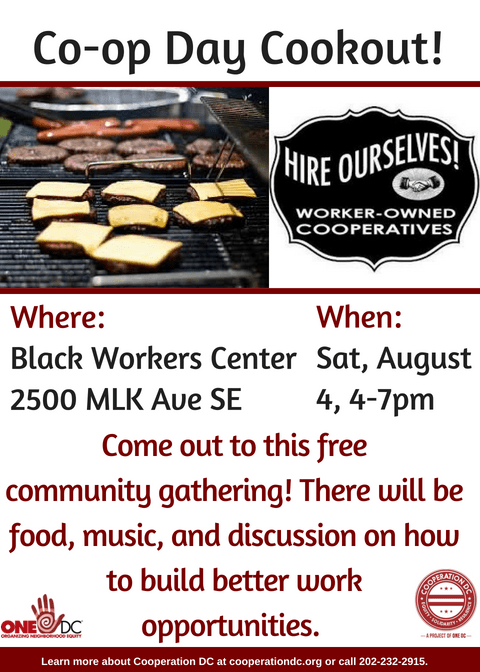
Cooperation DC, a project of the ONE DC Black Workers and Wellness Center, is celebrating its new home in Anacostia. To bring awareness to our move, we are inviting you to a cookout this Saturday August 4th from 4pm-7pm. Stop by the ONE DC Black Workers and Wellness Center (2500 Martin Luther King Jr. Ave, SE) to enjoy food, learn about the benefits of worker cooperatives in Ward 8 and throughout the District, and to brainstorm how Cooperation DC can uplift workers in Southeast. We would like to strategize with everyone that comes through about your vision for future dignified workplaces.
What is a worker cooperative?
A worker cooperative is a business that is owned and governed by its employees. Instead of being run solely for profit, a worker cooperative operates with shared leadership at its core. It measures its success in the wellbeing of its members, its sustainability as a business, and its contribution to the communities and environments in which it operates.
Why worker cooperatives?
– Better wages, better benefits
– Higher quality jobs
– Worker control over jobs and work environment
– Increased job security
– Prioritization of human, community, and environmental needs over product/profit

